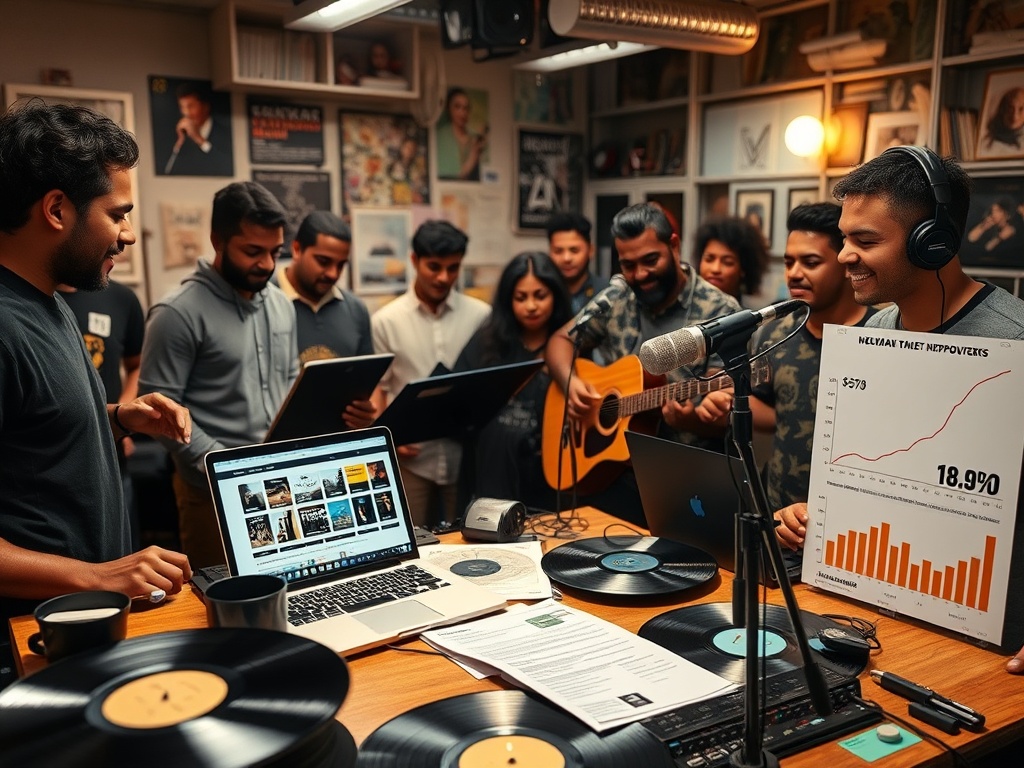
Beyond Solo Success: How Collaboration Creates Sustainable Income for Musicians
Discover how strategic collaborations, partnerships, and collective projects create multiple revenue opportunities and build long-term income stability for independent musicians.
The Solo Artist Myth
There’s a romantic notion of the solo artist: genius working alone in a studio, creating masterpieces that change the world. It’s a nice story. It’s also economically fragile.
The most sustainable music careers aren’t built by individuals grinding alone. They’re built by musicians who understand the power of collaboration—not just creatively, but financially.
Collaboration isn’t just about making better music. It’s about creating multiple revenue streams from a single project.
Why Collaboration Creates Income
One Song, Multiple Revenue Sources
When you collaborate, that single piece of music can generate income in multiple ways:
- Streaming revenue shared among collaborators
- Sync licensing opportunities multiplied by the combined audiences
- Publishing splits between co-writers and producers
- Cross-promotion through collaborators’ fanbases
- Potential for remixes, covers, and derivative work
One collaboration might be heard by 100,000 new listeners through your co-creator’s fanbase. That’s income you wouldn’t have made alone.
Reduced Risk Through Shared Investment
Studio time is expensive. Marketing costs money. Promotion requires resources.
When you collaborate, you’re sharing those costs. A producer covers studio time. A co-writer brings connections that lead to placements. An artist brings an audience.
Suddenly, projects that seemed too expensive become viable.
Access to Bigger Opportunities
Alone, you pitch your music to supervisors hoping they’ll listen. With collaborators, you have access to their networks.
A producer knows supervisors. A songwriter knows publishers. An established artist opens doors. These connections create opportunities you couldn’t access independently.
Types of Collaborative Income
1. Writing & Production Partnerships
Co-writing generates revenue that solo writing doesn’t. You write a song with someone. If that song gets placed, you both earn.
More importantly, your collaborator might have placements you never would have accessed alone.
Example: You write with a producer who’s been placed in 10 commercials. Your collaboration song lands in a commercial. Revenue: $5,000+. You couldn’t have made that on your own.
2. Artist Collaborations
Featuring on someone else’s track. Having someone feature on yours. Both generate income:
- Streaming revenue is split
- Sync opportunities multiply (two fanbases = more potential placements)
- Cross-promotion reaches new audiences
- Remix opportunities emerge
The combined reach of both artists creates income neither could generate alone.
3. Project-Based Collaborations
Creating a compilation, sample pack, or EP together. Shared costs. Shared revenue. Shared exposure.
A 5-artist compilation might sell 500 copies at $5 each. That’s $2,500 revenue split among creators, plus streaming revenue, plus cross-promotion benefits.
4. Production Collectives
Musicians pooling resources to create a production library, beat pack, or music service. Shared infrastructure. Shared revenue.
One producer might not generate enough beat sales. Five producers working collectively? They have enough volume and variety to build meaningful income.
5. Educational Collaborations
Teaching together. Creating courses together. Running workshops together.
A solo course might sell to 50 people at $50 = $2,500 revenue. A course by two respected musicians might sell to 200 people = $10,000 revenue.
Your collaborator’s audience becomes your audience. Your credibility is reinforced by association.
6. Royalty Sharing Arrangements
Some musicians create ongoing royalty-sharing arrangements with collaborators. You’re entitled to a percentage of their streaming revenue. They’re entitled to a percentage of yours.
It sounds counterintuitive to “give away” revenue. But if your collaborator brings 10x more listeners, that percentage grows your total income.
How Collaborators Create Multiplier Effects
Network Effect
You have 5,000 followers. Your collaborator has 3,000. Alone, you reach 5,000. Together, you reach 8,000+ (some overlap, but combined reach is significant).
Now multiply this across multiple collaborations. You’re reaching exponentially more people with every project.
Credibility Through Association
When you collaborate with someone established, some of their credibility transfers to you. Music supervisors see a placement by “Artist A (established) + Artist B (new).” Suddenly, Artist B has implied credibility.
This opens doors. Better opportunities. Higher placement potential. More income.
Skills & Perspectives
A producer brings technical expertise. A songwriter brings lyrical depth. An artist brings performance energy. A business person brings marketing strategy.
Each collaboration makes the end product better. Better products get placed more. Better placed products generate more income.
Time & Resource Efficiency
Creating music alone is time-intensive. With collaborators, you’re dividing labor.
The producer focuses on production. The songwriter focuses on lyrics. The marketer focuses on promotion. More gets done faster. Projects generate income quicker.
Real Collaborations That Generate Real Income
The Producer + Songwriter Model
A producer creates 5 beats per month. A songwriter creates 5 songs per month. Separately, each generates ~$500/month in streaming.
Together, they co-create 5 songs/month with shared revenue. Those collaborations are higher quality, more marketable, and more likely to get placed.
Combined monthly income: $2,000+. That’s a 4x multiplier compared to working separately.
The Artist Feature Model
Artist A has 10,000 followers. Artist B has 8,000 followers. They create a song together.
Combined reach: 18,000+ potential listeners. Each release on both artists’ channels. Double the playlist pitching. Double the promotional channels.
Revenue per collaboration: $1,000+ from streaming + sync opportunities. 4-6 collaborations per year = $5,000-6,000 annual income purely from collaboration revenue.
The Collective Label Model
5 musicians form a collective label. Each releases solo music on the collective label. They share promotion, playlist pitching, and marketing costs.
Individual streaming might generate $300/month. Through the collective, combined exposure generates $2,000/month split among creators. Each person earns $400/month while contributing to others’ earnings.
Building Your Collaboration Network
Start With Complementary Skills
Don’t collaborate with 5 singers. Collaborate with people whose skills complement yours.
A songwriter + producer. A composer + an artist. A beat-maker + a vocalist. Complementary skills create magic.
Pick People With Aligned Networks
Your collaborators should bring access to different audiences, platforms, and opportunities than you have.
If you both have TikTok-only audiences, your reach doesn’t expand much. If one has industry connections and one has fan engagement, your opportunities multiply.
Start Small, Think Long-Term
Your first collaboration doesn’t need to be a massive project. A single co-written song. A remix. A feature.
Use it to build trust and see if your styles work together. Best collaborations often turn into ongoing partnerships.
Communicate About Revenue
How are you splitting income? Who owns publishing? What’s the timeline? Get this in writing before creating.
Transparent financial communication prevents friendship-ending disputes later.
The Collaboration Income Timeline
Months 1-3: Building relationships, defining projects, creating music
Months 4-6: Pitching for sync. Uploading to platforms. Cross-promoting.
Months 7-12: First income from collaboration arrives. Relationships deepen. Second collaboration starts.
Year 2+: Multiple ongoing collaborations generating stacked income. Your network has exponentially expanded.
A single collaboration might take 6 months to generate meaningful income. But 3-4 overlapping collaborations means you have stacked income hitting at different times.
That’s income stability.
Why Musicians Avoid Collaboration
Fear of Losing Control
Your music is personal. Collaboration means compromise. But compromise creates products that appeal to more people, which creates more income.
Conflict Concerns
What if you disagree on direction? What if financial disputes happen?
These are real risks. But they’re manageable with clear communication and contracts. The income potential outweighs the risk for most musicians.
Imposter Syndrome
“Why would an established musician want to collaborate with me?”
Often they would. They see potential. They like your work. They want fresh energy in their project.
Time Constraints
Collaboration requires coordination. Scheduling calls. Exchanging files. Giving feedback.
Yes, it’s more work than solo creation. But the income multiplier often justifies the time investment.
The Strategic Approach
Don’t do collaborations randomly. Do them strategically:
- Identify gaps in your income or audience reach
- Find collaborators who fill those gaps
- Create quality work together
- Pitch strategically to supervisors and platforms
- Collect data on what works
- Deepen relationships with high-performing collaborators
- Repeat with other collaborators who fill different gaps
This isn’t art for art’s sake. This is strategic income building.
The Sustainability Factor
Here’s what makes collaborative income sustainable:
You’re not dependent on a single fanbase growing. You’re distributed across multiple networks. If one platform changes, you have others. If one collaborator stops creating, you have others.
Your income has built-in redundancy. That’s what sustainability looks like.
Beyond the Money
Yes, collaboration creates income. But it also creates:
- Community — You’re part of something bigger than yourself
- Creative growth — You learn from collaborators’ approaches
- Mental health — You’re not grinding alone
- Opportunities — Each collaboration opens new doors
The music career that’s just financially sustainable is one thing. A music career that’s financially sustainable AND creatively fulfilling AND surrounded by community? That’s the dream.
Collaboration delivers all of that.
Your Next Step
Who’s one musician you’ve wanted to collaborate with? Someone whose skills complement yours. Someone whose audience is different from yours.
Reach out. Suggest a small project. See where it goes.
That collaboration might be the beginning of your sustainable music career.
Most likely? It will be the first of many.